2006 Britt Stokes
Quick answer: Tempered glass is annealed float glass that has been heated and rapidly cooled, locking compression into the surfaces and tension into the core. This makes it approximately four times stronger in bending than standard glass and causes it to dice into small, blunt fragments when broken, which is what qualifies it as safety glazing.
If you’ve ever searched “what does tempered glass mean” and landed on an explanation full of engineering jargon, this post is for you. The goal of this plain-language guide is simple: explain what tempering actually does to glass, how to tell if glass is tempered in the field, and why the distinction matters when glass is doing structural work.
At Circle Redmont®, glass type is an engineering decision with real performance and safety consequences, not a cosmetic one. That means you can trust our expertise as a manufacturer of engineered structural glass systems for over 60 years.
What Does Tempered Glass Mean, and How Is It Made?
The process starts with standard annealed float glass. That glass is heated to roughly 1,150 °F, then blasted with jets of cool air on both surfaces simultaneously. The surfaces set first. The core cools afterward and contracts, which places the surfaces under permanent compression and the interior under tension.
That stored stress is what makes tempered glass stronger. Glass fails in tension at surface flaws (small scratches, inclusions, edge chips). Because the surfaces are under compression, any flaw must first overcome that compressive force before it can propagate. The result: fully tempered glass is roughly four times stronger in bending than annealed glass of the same thickness.
The fracture behavior follows from the same physics. When the compressive layer is finally breached, all that stored energy releases at once, and the pane dices into small, relatively blunt fragments rather than long, sharp shards. That characteristic break pattern—not the strength alone—is why it qualifies as safety glazing.
Tempered vs. Other Glass Types
So what does tempered glass mean relative to the alternatives?
Annealed glass is standard float glass with no heat treatment. It can be cut, drilled, and edged after fabrication. When it breaks, it produces large, sharp shards.
Heat-strengthened glass undergoes a similar heating process to tempered but cools more slowly, yielding roughly twice the strength of annealed glass, with lower surface compression than tempered. When it breaks, it stays in larger fragments that tend to remain in the opening, making it often the better choice for laminated overhead glazing.
Laminated glass is a construction, not a heat treatment. Two or more glass plies are bonded with an interlayer. When broken, the piece holds together, something tempering doesn’t provide. Demanding assemblies frequently combine both approaches, using tempered or heat-strengthened plies within a laminated makeup to achieve both strength and post-break retention.
Heat-treated glass follows ASTM C1048 standards, while CPSC 16 CFR 1201 and IBC dictate safety glazing requirements in hazardous locations for impact resistance and injury prevention.
How to Tell If Glass Is Tempered
Knowing how to tell if glass is tempered is useful on-site, during a renovation, or when evaluating an existing assembly. There are four reliable methods.
Look for the safety glazing stamp. The most definitive indicator is a permanent mark—sometimes called a “bug”—that’s been sandblasted or ceramic-fired into a corner of the glass. It identifies the fabricator and applicable safety standard. One caveat: framing can obscure it, and older or non-safety-rated units may not have one.
Use polarized sunglasses. This is the next easiest method for telling if glass is tempered. Hold a polarized lens up and rotate it slowly while looking through the glass in daylight. Tempered glass shows faint dark spots, stripes, or a shadowy grid pattern from the quench nozzles used during manufacturing. Annealed glass shows nothing.
Check the edges. Because tempered glass must be cut and finished before heat treatment, its edges are typically smooth, seamed, or polished. A raw or freshly nipped edge suggests the glass was never tempered.
Sight down the surface. Look at a shallow angle across the face of the glass. A slight waviness or reflected distortion is a byproduct of the furnace rollers used during tempering—common on tempered glass, absent on annealed.
Why Glass Type Matters in Structural Applications
So what does tempered glass mean for specific applications? Choosing the right glass type directly affects structural performance, safety margins, and long-term reliability. Here’s where tempered glass makes a measurable difference:
Walkable and load-bearing surfaces
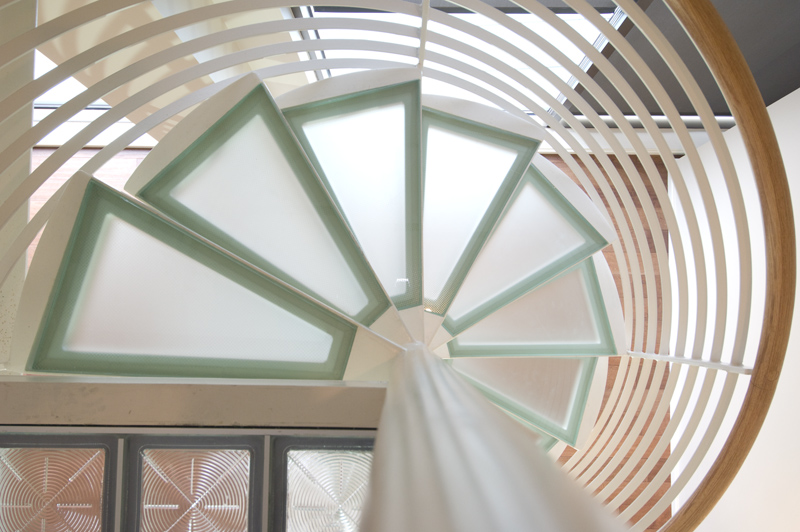
Glass floors, stair treads, and bridges carry live loads, point loads, and impact forces. Heat treatment raises the allowable bending stress, making workable panel thicknesses achievable where annealed glass would require impractical thickness to perform safely.
Overhead and sloped glazing
Anything above occupied space needs post-breakage retention, which is why heat-treated plies are laminated rather than used monolithically. If a ply breaks, the interlayer holds the fragments in place.
Thermal stress
Partial shading, dark interior finishes, and applied films create differential heating across a pane. Heat-treated glass tolerates thermal gradients that would crack annealed glass outright.
The Limitations
- Once tempered, glass can’t be cut, drilled, or edge-modified. All fabrication happens before the furnace, so a field change means ordering a new panel.
- Edges and corners are the most vulnerable points, where the compressive layer is thinnest.
- Rare spontaneous breakage from nickel sulfide inclusions is a known risk; heat-soak testing reduces it in critical applications.
- Tempering does not improve scratch resistance or stiffness; deflection is governed by thickness, span, and geometry, not heat treatment.
One more thing worth noting: specifying “tempered glass” without addressing the surrounding assembly is an incomplete specification. Panel thickness, lamination makeup, span, support conditions, framing, sealants, and fasteners all determine how a glass assembly performs under real-world load.
Talk to the Circle Redmont® Team
Circle Redmont® engineers structural glass systems where glass type, lamination makeup, and framing are designed together. Our product lines include the 91R™ Structural Glass Paver & Metal Systems for commercial foot traffic, the 91R™ Plank Glass & Metal Systems for floors, bridges, and stair treads, and the Elite™ and SolarWhite™ Glass Block & Metal Systems for vertical or horizontal daylighting applications.
If you’re working through a specification and want to talk through glass type selection, load requirements, or assembly details, our team has been doing exactly that for over 60 years. Reach out to Circle Redmont® and tell us about your project.